
Unstuck: What Seth Godin's Mentor Deck Taught Me About Bridging Human and Digital Worlds
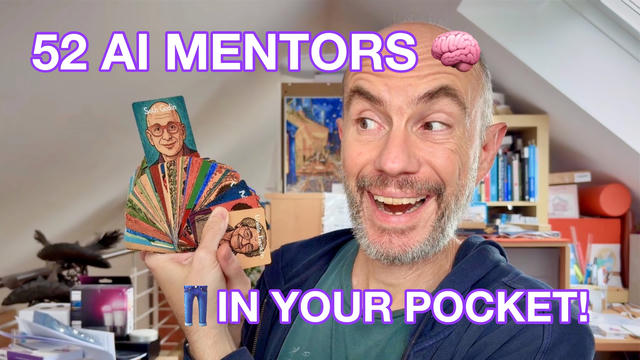
A package arrived a few months ago. Inside: a deck of cards with a red telephone on the box. “The Mentor Deck” by Seth Godin.
I’m a beta tester, so I got one of the first 2,000 decks ever made. Each card has a QR code on the back that launches an AI conversation with a virtual mentor—Seth himself, or Gandhi, or Charles Darwin, or one of 49 other thinkers.
Cool idea, right? But here’s what made me excited: I’d already been experimenting with inviting virtual mentors into my AI conversations for months. And seeing Seth’s physical cards made something click.
This wasn’t just about AI mentors. It was about something bigger.
The Deck Itself
Let me show you what I mean. I made a quick video walking through the deck—what it is, how it works, and even a peek at the code behind these AI conversations:

It’s a simple but powerful idea: when you’re stuck, you shuffle through the cards, find someone who might help with your specific challenge, scan the QR code, and start a conversation. The physical ritual of shuffling and choosing creates a moment of intentionality. The QR code bridges you to a Claude artifact that’s been carefully crafted to embody that person’s thinking.
It’s elegant. But as I played with it, I realized something.
The Pattern Emerges
Seth’s Mentor Deck does two things that my “invite a virtual mentor” approach doesn’t:
First, it’s physical. You hold cards. You shuffle them. You make a choice. There’s something powerful about that tactile experience when you’re stuck. It creates a ritual, a moment where you step away from your screen and think: “Who do I need right now?”
Second, it’s curated. Instead of the infinite possibility of “I could invite anyone into this conversation,” you have 52 specific voices. That constraint is actually freeing—you discover thinkers you might not have thought to invite. The curation does the work of helping you find what you didn’t know you needed.
And then it hit me: this is the same pattern I’d been using in a completely different context.
A few months ago, I spent way too much time creating an NFC tag system for playing music in my house. I curated playlists, connected them to my Home Assistant setup through automation, and put physical NFC tags around the house. Touch a card, music plays. Different pattern, same structure: curated content + tech interface + physical trigger.
The pattern crystallized:
Curated Knowledge + Tech Interface + Physical Bridge = Help Where Humans Actually Are
This Idea Is Older Than AI
Here’s where it gets interesting. Seth’s Mentor Deck reminded me of something from 1975: Oblique Strategies, a deck of cards created by Brian Eno and Peter Schmidt.
Oblique Strategies was designed to help artists get unstuck. Each card had a cryptic prompt—things like “Honor thy error as a hidden intention” or “What would your closest friend do?” The physical ritual of drawing a card created space for new thinking.
That was 50 years ago. No QR codes. No AI. Just cards and human wisdom.
Seth’s deck takes that same insight—that physical prompts can unlock mental blocks—and bridges it to something Eno and Schmidt couldn’t have imagined: AI-powered conversations that adapt to your specific situation.
It’s not just an evolution of technology. It’s an evolution of how we help each other get unstuck.
Why This Pattern Works
Three things have to come together:
Curation matters. You can’t just point people to “all the information on the internet” or “talk to any AI mentor you want.” That’s overwhelming. The magic is in selecting the right 52 cards, the right experts, the right prompts. Constraints create clarity.
AI as interface matters. This isn’t about linking to static documents or pre-recorded videos or music playlists. The AI can have an actual conversation, adapt to your situation, ask follow-up questions, and guide you deeper. It’s not just retrieval—it’s human-centric dialogue.
Physical triggers matter. Cards you shuffle. Tags you touch. QR codes you scan. These create intentional moments in the physical world where you’re struggling. They bridge the gap between “I’m stuck at my desk” and “I’m having a conversation with someone who can help.”
What You Could Build
Now I’m thinking: what else could follow this pattern?
Museum guides: QR codes next to exhibits that launch conversations with AI docents who can answer questions about the art, the history, the technique—tailored to your level of interest.
Manufacturing floors: QR codes on machines that connect workers to AI troubleshooters trained on repair manuals, safety procedures, and common issues. This is already happening at large manufacturing companies, but why not everywhere, like the workshop round your corner?
Classrooms: Physical cards with prompts that launch AI-facilitated discussions, helping students explore topics at their own pace.
Therapy or coaching: Cards for different emotional states or challenges, each launching a supportive AI conversation trained on relevant frameworks.
Retail stores: QR codes on products that don’t just show specs, but start conversations about use cases, comparisons, or creative applications.
The pattern is everywhere once you see it. Anywhere people get stuck in the physical world, you can bridge them to curated knowledge through AI.
A Note on the Mentor Deck Itself
The original Kickstarter campaign for the Mentor Deck has ended, so you can’t get one right now through that channel. But honestly? That’s not the point of this post.
The point is the pattern. The Mentor Deck is one beautiful implementation, but the idea—curated expertise + AI + physical bridges—belongs to anyone who wants to build with it.
You can try a sample conversation from the deck here to see how it works. And if you want to follow when the deck becomes more widely available, check Seth’s announcement or the Prompt Decks website (with two additional decks, one on “Positive Divination” and one on “Infinite Adventures”, following similar patterns).
Your Turn
Here’s your challenge, should you accept it: what can you build with this pattern?
Think about the people you serve—your students, your customers, your team, your community. Where do they get stuck? What knowledge do they need in those moments? How could you curate it, make AI the interface, and give them a physical way to access it?
I’d love to hear your ideas! Tell me or share what you create and link to this post—I’m collecting examples of this pattern in action. Let’s see what’s possible when we bring curated knowledge to people where they actually are.
Resources
Try it yourself:
- Sample Mentor Deck conversation—see how these AI conversations work
- My previous post on inviting virtual mentors—the flexible approach
Learn more:
- Seth Godin’s announcement of the Mentor Deck
- Prompt Decks website
- Oblique Strategies—the 1975 deck that started it all
- My NFC music automation project—another example of the pattern
Update (2025-11-26) The prompt decks, including the updated Mentor Deck, are now available