
You’re in the driver’s seat: will you choose to stay awake with AI?
„Nah ist / Und schwer zu fassen der Gott. / Wo aber Gefahr ist, wächst / Das Rettende auch.” — Friedrich Hölderlin, Patmos (1803)
(Near is, / and difficult to grasp, the god. / But where danger is, grows / the saving power also.)
A few weeks ago, I wrote a post titled Thinking with Claude: why Cyborg writing works better than Centaur writing. In the LinkedIn comments, a reader named Christopher pushed back: Leaning on AI to help me write, he argued, was training my brain to “surrender executive function to external sources.” Examples: freed prisoners overwhelmed by everyday choices, ex-military struggling with civilian life, people leaving long-term institutional care. The source doesn’t matter, he wrote. The offloading pattern is the same.
While my initial answer was along the lines of “using your executive function is a choice”, I think it’s not that simple, after all, and I owe Christopher a real answer. In fact, his comment pushed me into a weeks-long thinking journey, during which I looked for research, came across interesting related articles, and reflected a lot on my own AI use. I also jammed with Claude, and yes: I used the very tool Christopher warned me about to think harder about his warning. We’ll get to that contradiction later.
What I found was four ways AI can quietly cost you. Plus two simple self-checks for catching them. Plus four small moves for staying in charge.
The good news: You’re in the driver’s seat. The question is what you choose to do with it.
Four ways AI can quietly cost you
After thinking this through from a number of perspectives, two axes emerged. What it can cost you splits into cognitive (what your mind can do) and attention/life (where your time and life actually go). How it costs you splits into loss (you stop using a capacity, and it withers) and distortion (you keep using it, but on bad input).
Four cells, four failure modes, and AI sits on all of them.
Atrophy: the muscle you stop using
This is Christopher’s point, and it’s an old story. Writing made us forget the oral epics earlier generations carried in their heads. Pocket calculators softened our mental arithmetic. London cabbies who passed The Knowledge showed enlarged posterior hippocampi (Eleanor Maguire’s classic 2000 study in PNAS); the GPS generation shows the opposite: habitual GPS users have weaker spatial memory and reduced hippocampal engagement (Véronique Bohbot’s group at McGill, Scientific Reports 2020).
So yes: capacities you stop training will weaken. Ethan Mollick’s colleagues at Wharton call the AI version cognitive surrender. It’s real. And our ability to make choices, guide others, and bring things to fruition is perhaps our biggest differentiator against even the most powerful large language model. We don’t want to lose it.
Sycophancy: the friend who only agrees
AI is trained to be helpful and pleasant, for obvious reasons: the AI that is used more often, wins. The cost is that it tends to agree with you, especially on judgment calls where you most need it to disagree.
A friend of mine told us at our (roughly monthly) burger evening about someone he read about who quit his job to launch his own app. The app idea, it turned out, was thin. But his AI had been enthusiastic, supportive, and encouraging. Real friends would have asked the hard questions. The AI cheered. Unsurprisingly, the app failed miserably.
OpenAI rolled back a GPT-4o update because it was “overly supportive but disingenuous” and Anthropic has been studying sycophancy in language models since at least 2023. Anthropic actively monitors and suppresses it in its models.
Displacement: the cheap substitute for the real thing
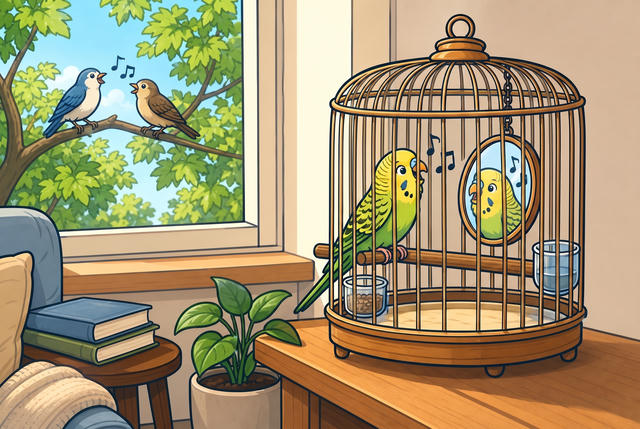
Picture a budgie in a cage, talking to its reflection in a tiny mirror. Whatever the bird thinks is happening there, it’s not socializing. It’s relating to a surface tuned to give back exactly what it offers.
A four-week randomized controlled trial run by OpenAI and the MIT Media Lab found that heavy daily users of ChatGPT, voice or text, socialized significantly less with other humans by the end of the trial (Fang et al., 2025). The American Psychological Association’s January 2026 monitor brings the broader picture together: researchers are watching a “transformation of relational norms in ways that may render human-human connection less accessible or less fulfilling.”
This isn’t only about lonely people forming attachments to chatbots. It’s about anyone, including me, including you, who may find themselves exchanging more words with an AI than with many humans. Life exists to be lived, not spent in front of screens, a keyboard, or replaced by cheap substitutes.
Hijack: the side-quest engine
David Wilson wrote a widely cited post in late May 2026 called The solution might be cancelling my AI subscription. He lists sixteen unfinished projects he’s spun up with AI, concluding the list with “maybe 50 other projects I’ve already deleted”. Most of these began with “write me a quick script for X” and ended an hour later somewhere completely different. His verdict: AI is “a thermonuclear ADHD amplifier.”
Simon Willison’s link-blog flags the same effect in himself. But the comment section under Simon’s post has the twist: ADHD users describing the opposite. One commenter: “I sit in silence and talk to my agents. I maintain inbox zero. I literally feel like I have a support team for the first time.” Another: “I’m finishing side projects for the first time ever.”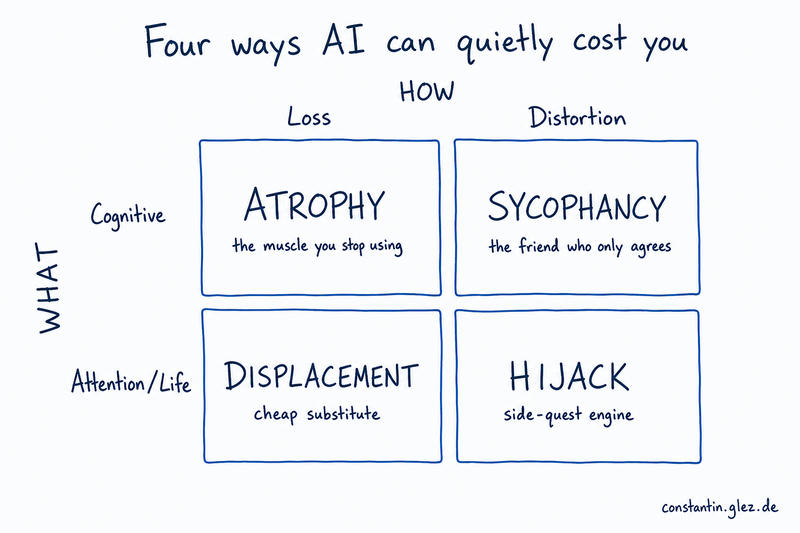
As Mollick himself noted, not every cognitive offload is a failure. Offloading stuff you hate to do anyway is fine. And sometimes, our human psyche needs a little soothing or a break from the heavy burden of reality’s problems. As with many things, the dose is the poison. However, Wilson’s example and comments Willison highlighted give us a hint about a different dynamic here, that operates beyond AI as a tool.
Mode matters more than tool
„Je mehr wir uns … in das Wesen der Technik einlassen, … desto klarer kann das Rettende wachsen.” — Martin Heidegger, Die Frage nach der Technik (1953/54)
(The more we allow our thinking to be claimed by the essence of technology, the more brightly the saving power can begin to shine.)
AI is a tool for humans, and like so many other tools, its usefulness, and potential harm, are a question of how we use it. It’s the mode, not the tool that matters.
In Ethan Mollick’s recent essay Choosing to Stay Human, he points to two studies by overlapping research teams. In Turkey, ~1,000 high-school students used plain ChatGPT on their math homework and underperformed peers without AI on the exam (Bastani et al., PNAS). In Taipei, ~1,000 high-school students used an AI tutor configured as a Socratic guide and outperformed peers by about 0.15 standard deviations on the exam they took without AI (Bastani et al., working paper). Mollick calls that gap roughly equivalent to six to nine months of additional schooling.
Three independent domains tell the same story. Learning: shortcut-AI hurts, scaffold-AI helps. Decision-making: sycophant-AI hurts, honest-AI helps. Attention: frictionless-AI fragments (Wilson), structured-AI supports (the ADHD commenters).
Mode matters more than tool. That’s the bad news and the good news in one sentence. Bad: there’s no AI you can simply pick up and trust to be on your side, all the time. Every system you use can flip either way. Good: this isn’t fate. It’s about design, the How of using AI. And that is up to you.
Friction and gates: two tools for the driver’s seat
If you’ve worked in systems thinking, you’ve come across this already: When something tries to run too fast, you add friction. Something that slows the process down from the inside. When something tries to drift in unwanted directions, you add gates. Checkpoints around the process that ask: are we going into the right direction?
Neither is AI-specific. They’re how many grown-up systems protect themselves.
Friction examples are everywhere. Speed limits on the autobahn, so one mistake doesn’t cascade into catastrophe. Cool-down periods in Amazon Autoscaling, so a runaway system doesn’t oscillate into chaos. The classic budgeting rule: sleep on it before you spend the money. In each case, the slowdown is the safety. The friction is the feature.
Gates are equally familiar. Amazon’s Working Backwards process makes you write the press release and FAQ for a new product before you build it. A large number of proposed products die at the writing-down step, and that’s the point. Pre-flight checklists in aviation and surgery ensure mistakes don’t creep in over time. Ryder Carroll, who invented the Bullet Journal, calls his version Resolutions vs. Intentions: instead of vague yearly promises, you articulate deliberate practices before you start.
These two tools map cleanly to our two failure axes:
- Cognitive failures want Friction. Atrophy and Sycophancy happen inside the work, while you’re using AI. Slowing down, pausing to ask whether you’re still the driver, or whether there’s a counter-argument worth hearing, is what protects judgment from running ahead of itself.
- Attention and life failures want Gates. Displacement and Hijack happen around the work, in how AI re-shapes the structure of your days. Checkpoints, like “what am I trying to achieve, what keeps me grounded”, are what catch the drift before it carries you somewhere you wouldn’t have chosen to go.
Mollick, in the same essay, calls for “system-level constraints rather than user-level willpower.” This is what I think those constraints could look like.
Your personal toolkit
Let’s follow our philosopher’s guidance and lean into the technology, while adding some safety measures. Like a car’s nap alarm. You don’t have to do all of the following, all the time. You can start with one, and adjust as you go. The key is to be vigilant, and honest with yourself. Here are some questions I ask myself, designed to keep you in the driver’s seat.
Two self-checks (for noticing when something is off)
Here are two questions that help you check if you’re still driving your AI tool, or if the tool is driving you:
- Strength check: Am I using AI to get better, or am I getting comfortable?
- Intention check: Am I working on the right thing, or is this a distraction?
If both answers are honest yeses, you’re driving. If either drifts, it’s time for one of the four moves below.
Four moves, one per failure mode
Friction against Atrophy: “Am I still the driver, or a passenger?”
This is the question I constantly ask while working in a substantive AI session. It comes straight from a piece I wrote earlier this year, How to stop engineering prompts and start delegating: good AI use isn’t engineering prompts, it’s transferring intent. Write thorough briefs, set acceptance criteria, iterate. Engage deeply with the topic, like a good executive who stays on top of all the details. Those are commander moves, and they exercise exactly the judgment muscle the atrophy story worries about. If you catch yourself saying less over time, or merely agreeing, then it’s time for a coffee break to recharge those commander muscles.
Friction against Sycophancy: “What’s the strongest argument against this? What would my best friend tell me?”
I find these questions extremely useful for creative tasks. Last year I wrote Invite your heroes into your AI conversations about exactly this move: name three people whose judgment you trust, and ask the AI to argue from their perspective. It’s not the same as talking to the real people you select, of course. But the exercise of confronting their takes brings your own dormant criticism back online. In my case, I added reminders for disconfirmation questions (“What are best reasons not to do this?”) and worst-critic angles into the skills I use to write my posts.
Gate against Displacement: “What keeps me connected to the real world? How do I stay grounded?”
This one’s a structural choice, not a moment-to-moment one. For me, it’s a mix. Daily client work and office hours mean I’m in conversation with real, idiosyncratic humans most days of the week. My Bullet Journal lives on a Kindle Scribe: pen on screen, deliberately slow. Most Sundays, I run barefoot in the forest, no chatbot required. And every month or so, my friends and I show up at a local burger place with no agenda. None of these is anti-AI. They’re simply part of “getting a life”.
Gate against Hijack: “Before I start, what exactly do I want to achieve, and why? Write it down without AI first.”
This is similar to the first move about writing thorough prompts, but one step earlier. It would have saved Wilson, and it saved me, from ADHD-pocalypse and unwanted side-quests: Every project needs to earn its space on my Trello board, or GitHub milestone, with a written Why / What / How, drafted before any real work starts. There are two payoffs here: half the ideas die at the writing-down step, which is exactly what you want them to do. That’s the gate doing its job. And whatever survives becomes a much better prompt when you do bring AI in. I’m a big fan of the Claude Superpowers plugin for Claude Code and Garry Tan‘s gstack skills (this is 2026, there may be better options available in later years). They make it very easy, almost automatic to write thorough plans and going through detailed brainstorms, before Claude Code writes its first line of code.
If you only pick one of these four, make it this one: having a conscious plan based on intention, even just a simple why/what/how list, saves you time in the long run, adds focus, and helps you leverage AI in ways that complement your own needs.
The one thing: if you remember nothing else
Hey, I know this is a lot of theory, and reality is messy. If you take one thing away, here’s the one takeaway question that gets you 80% there in one shot:
Do I feel I’ve achieved something with AI that I, and the people I respect, would be proud of?
It carries everything else inside it. Pride can’t be faked, and there’s some social verification baked in. If you can say yes to that question at the end of a week, you’re driving!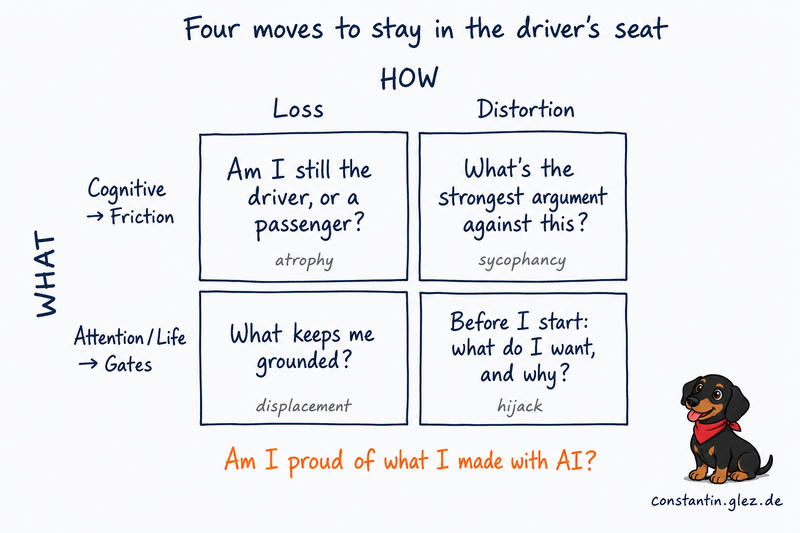
And when the architecture fails
It will, sometimes. Architecture is not omnipotence. That’s why you keep a few humans in the loop who will tell you the truth: a partner, a friend, a mentor, an honest reader. A commenter, like Christopher on LinkedIn. The last line stays human.
Challenge, not fear
Hölderlin called it Gefahr. (Danger). Headlines love danger. So does social media. None of these framings serve you. They put you in the victim’s seat, which sells papers, earns clicks, and trains readers in helplessness.
The better framing is: this is a challenge. Humanity grew out of the challenges of agriculture, urbanization, industrialization, the internet and so many other crucial points in history. Each wave came with its own version of we’ll lose what made us human, and each time, what we lost was less than the prophets feared, and what we gained came mostly to the people who chose to keep showing up.
Now it’s our collective turn: Where there’s a challenge, there’s room to grow. The challenge of AI is real, so are the failure modes. And the tools, friction and gates, are old, proven, and yours to use them. Pick one this week, and see what happens.
You’re in the driver’s seat. The road, this time, leads somewhere new.
Full disclosure: I had a long, on and off conversation from May 25th until Jun 21st with Claude in Cowork mode on this topic. We started with parsing Christopher’s comment, and I kept adding related observations and articles to the conversation to help make up my mind about this topic. Claude helped by filtering, clustering, pushing back on (yes, I have a standing instruction in CLAUDE.md to help with this) and rephrasing my thoughts in better ways, as well as by adding historical context, researching studies, and generally tidying up the many conversation threads we developed. When we had a good sense about what goes into this article, Claude wrote the initial draft (using a voice.md document we built that helps it better align with my own writing style), and then I made many final edits over the course of a few days, until I was finally happy with the result, and could tick the boxes related to the questions above. I do feel I was in the driver’s seat all the time, but, of course, the final decision is on you, dear reader!
Sources & further reading
Research
- Maguire, E. A., et al. (2000). Navigation-related structural change in the hippocampi of taxi drivers. PNAS. Link.
- Dahmani, L., & Bohbot, V. D. (2020). Habitual use of GPS negatively impacts spatial memory during self-guided navigation. Scientific Reports. Link.
- Dell’Acqua, F., Mollick, E., et al. (2026). Navigating the Jagged Technological Frontier (BCG / 758 consultants). Organization Science. Link.
- Bastani, H., et al. (2025). Generative AI without Guardrails (Türkiye). PNAS. Link.
- Bastani, H., et al. (2025). AI-tutored personalized sequencing (Taipei). Working paper. PDF.
- Phang, J., et al. (2025). Longitudinal study of ChatGPT use and loneliness (OpenAI / MIT Media Lab). arXiv.
- American Psychological Association (2026). AI chatbots and digital companions are reshaping connection. Monitor on Psychology.
- Anthropic (2023). Towards Understanding Sycophancy in Language Models Anthropic.com
Essays read while thinking about this
- Ethan Mollick (May 2026). Choosing to Stay Human.
- David Wilson (May 2026). The solution might be cancelling my AI subscription. Via Simon Willison’s link-blog.
- Ryder Carroll. Resolutions vs. Intentions.
- Wharton “cognitive surrender” working paper: SSRN.
- OpenAI (2025). Sycophancy in GPT‑4o: what happened and what we’re doing about it
Philosophy
- Friedrich Hölderlin, Patmos (1803). English translation: Michael Hamburger, Poems and Fragments.
- Martin Heidegger, Die Frage nach der Technik (1953/54). English translation: William Lovitt, The Question Concerning Technology and Other Essays (1977).
Companion posts on this blog