
SMART goals are failed Taylorism (and why you should ignore them)

A 25-year career without goals—and why that worked better than the alternative
This guitar is more than 15 years old. It’s my second one—the first was bought and sold in the ’80s.
I tried lessons. Self-teaching. Regular practice. Still couldn’t play a recognizable song. Now it collects dust, reminding me of an old dream that never quite worked out.
Then in 2018, my wife gave me a ukulele as a gift. Twenty minutes later, I was a musician.
Same dream. Different approach. And that’s exactly what this post is about—but not just music. It’s about unhealthy approaches to success, productivity, and “achieving our best year ever”.
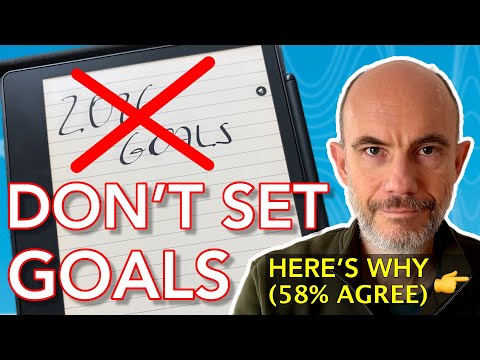
Prefer to watch? Here’s the gist in 8 minutes on video.
The resistance you’re already feeling
I ran a poll on LinkedIn recently, asking tech professionals: “Will you set goals for 2026?”
Fifty-eight percent said no. Another 5% said “Dunno…”
That’s nearly two-thirds of people who probably feel guilty right now. Everyone’s posting their goal sheets, their vision boards, their quarterly targets. The productivity industrial complex is in full swing, telling you that without SMART goals, you’re doomed to mediocrity.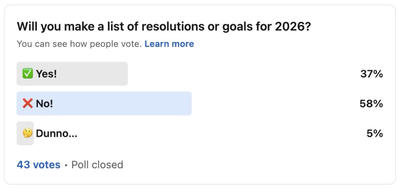
And you may be sitting there thinking: “Should I be doing that too?”
Here’s what I think: If you’re avoiding goals, you’re not lazy. You’re smart.
The resistance you feel is not weakness. It’s human. Your brain is protecting you from something that fundamentally doesn’t fit knowledge work.
SMART goals are failed Taylorism
Let’s start with a quick history recap about Frederick Winslow Taylor.
In the early 1900s, Taylor revolutionized factory work with “scientific management”—later called Taylorism. He studied workers with stopwatches, broke tasks into tiny steps, and optimized every movement. For shoveling coal or assembling car parts, it was brilliant.
Workers became more efficient. Productivity soared. Management loved it.
There was just one problem: Taylor himself acknowledged his system wouldn’t work for knowledge work, as Cal Newport pointed out in his book A World Without Email.
Taylorism assumes workers are interchangeable cogs executing predefined, repetitive tasks. Knowledge work instead, is very different.
But management tried anyway.
SMART goals—Specific, Measurable, Attainable, Relevant, Time-bound—are Taylorism 2.0. An attempt to force industrial-age thinking onto creative, dynamic, knowledge-intensive roles.
And it fails. Spectacularly.
Why each SMART element breaks down for creative work
You can’t be Specific while adapting to rapid change. Solutions architecture, product development, customer success—these roles require flexibility. The moment you lock in “specific,” reality shifts and your goal becomes obsolete.
You can’t Measure creativity, learning, or customer impact with a single number. How do you quantify “helped a customer transform their business”? How do you measure “became a better mentor”?
You can’t know what’s Attainable when the future is unpredictable. What if you can do more than you think? What if the market shifts? Setting “attainable” goals often means setting artificially low ones to avoid failure, or artificially high, “stretch” goals.
Relevant is arbitrary. Who decides what’s relevant? Your manager? The leadership team? The productivity guru on YouTube? True relevance comes from understanding your purpose, not checking a box.
And Time-bound creates artificial pressure. Why is December 31st magical? Why does failing to hit a number by an arbitrary deadline mean anything? What if you hit your goal early, on October? Should you stop working and take the rest of the year off?
To be clear: For repetitive, structured tasks, goals work, just like Taylor demonstrated. It’s in creative, adaptive work where they break down.
In his book The Infinite Game, Simon Sinek points out that most games in life and in business don’t have winners, losers, or even clear rules. Instead, they’re infinite games, where the only goal is to stay in the game for as long as possible. That requires creativity, flexibility, and adaptability, because the rules of infinite games can be influenced, and they keep changing all the time.
The three psychological problems with goals
As Anne-Laure LeCunff points out in her book Tiny Experiments, there are three, key psychological problems with these types of goals:
First, goals create fear and paralysis. You set a big goal, then freeze. Too many options. Too much doubt. Insecurity creeps in.
Second, they encourage toxic productivity, the hamster wheel effect. You chase random numbers, sacrifice everything else, risk burnout. And then the constant internal dialogue: “Did I do enough?”
Third, they make you compete instead of collaborate. Everyone’s focused on their own ladder, climbing alone, measuring themselves against others.
My 25 years without goals
I spent over 25 years at Sun Microsystems, Oracle, and Amazon Web Services. Eventually, I became a Principal Solutions Architect, coaching executives and helping companies transform.
During that time, I never sat down and wrote professional goals for myself.
Well, that’s not entirely true. A few times, managers asked me to write goals. So I did, and made lists of stuff I thought they expected. Then ignored them.
At the end of a year, I still got good performance reviews. Those goal sheets hardly came up then.
Why?
Highly creative, dynamic, customer-focused tech roles don’t work like factory worker roles. Solutions architecture is about learning, helping customers, adapting to change. You can’t put “be creative” or “adapt to emerging technologies” on a SMART goal spreadsheet.
Even the best sales people I know, which are in a job that literally runs on goals, tended to ignore their numbers in their day to day work, and instead focused on transforming their customers. They also ended the year over-achieving their goals by a large margin.
A real-world example
In recent years, I’ve seen a lot of goal sheets. Sometimes long Excel tables with many rows of detailed goals. You know the saying: “If everything is a priority, nothing is.”
I signed up for owning one of these goals—a revenue metric attached to a category of products—because I recognized the meaning behind it. Then, I worked with a few colleagues on moving it forward.
The first thing I did was ignoring the number.
Instead, I focused on the key customer value behind the goal, the “why”, and which actions we could facilitate to help customers get more value.
That motivated the team: We were solving real problems for customers, not chasing arbitrary metrics.
The ironic twist: a different part of the team worked on getting better data to track the goal. After cleaning up the data, the number went up significantly. Go figure.
The lesson here is: when you focus on real value, the numbers take care of themselves.
Goodhart’s law: when metrics become targets
There’s a principle in economics called Goodhart’s Law: ”When a metric becomes a target, it ceases to be a good measure.”
The moment you make a metric your goal, you distort the system. People game it, optimize for it, lose sight of what actually matters.
Metrics are useful! I’m not saying “ignore the data.” Instead, think of metrics like a car’s dashboard:
You don’t drive staring at the speedometer, do you? You glance at it to avoid failure, like speeding tickets or running out of gas. But your eyes stay on the road, focused on where you’re going.
The speedometer informs. It doesn’t control.
That’s how metrics should work in your career, your projects, your life. They provide useful information and direction, but they are not the destination. They’re not a replacement for knowing your “why” or seeing what’s actually happening around you.
Metrics are essential for understanding reality—just not for replacing judgment about what matters. Amazon’s “Dive Deep” leadership principle sums it up:
Leaders operate at all levels, stay connected to the details, audit frequently, and are skeptical when metrics and anecdote differ.
My @Constant.Thinking YouTube channel’s subscriber count is at 64 right now. By YouTube standards, that’s nothing. But I don’t obsess over the growth rate. I make a video every week, pay attention to what resonates, and enjoy the process.
The number informs me. It doesn’t define me.
A better way: intentions and the Autonomy/Mastery/Purpose framework
If not SMART goals, then what?
Focus on transformation instead of achievement. Focus on who you want to become, not what you want to get.
Dan Pink nailed this in his book Drive (you can also watch his TED talk The puzzle of motivation). He researched motivation and found that traditional carrot-and-stick methods work for simple, repetitive tasks—but fail miserably for knowledge work.
Instead, three things drive us:
Autonomy: Staying in control over what you do, instead of following rigid orders.
Mastery: Focusing on getting better every day, not hitting a one-time milestone.
Purpose: Connecting to the deeper “why,” not some surface-level metric.
Goals are contrary to all three. They remove autonomy (someone else sets the target), they prioritize outcomes over growth (hitting the number matters more than learning), and they often disconnect from real purpose.
Intentions restore them.
How to find your intention
Use the 5 Whys technique: Start with something that sounds like a goal and keep asking “why” until you reach the core intention.
Example: “I want to run a marathon.”
Why? “To get fit.”
Why? “To have more energy.”
Why? “To feel healthy.”
There it is. Your real intention: “Become a healthy person.”
(It doesn’t have to be exactly five. Just keep asking until you feel you found your intention.)
The difference: Running a marathon is a one-time event. Becoming a healthy person lasts forever. And it changes what you do daily.
Build the daily system:
Once you have your intention, ask: What do people like that do every day?
Healthy people eat real food. They move daily. They sleep well.
Great! Now you can start doing one or more of those things today.
Congratulations! You’re already a healthier person.
This won’t be perfect on the first day. But it’s better than yesterday. And if you keep going—eat better tomorrow, move more, sleep well—small wins will compound. You’ll be amazed what happens in 30 days. A quarter. A year.
James Clear explains this in great detail in his book Atomic Habits and his article “Forget About Setting Goals. Focus on This Instead.” Systems beat goals every time.
Back to my ukulele story
With guitar, I had a goal: “Learn guitar.” It felt big, scary, endless. Exercises felt like homework.
With ukulele, I set an intention: “Become a musician.”
What do musicians do? They play. Every day.
So I played the ukulele every working day after breakfast. Just 20 minutes. No pressure. No milestones. Just music.
I felt like a musician from Day 1. Not after years of practice—from the very beginning.
That’s the difference. Instead of chasing some future achievement, I focused on becoming someone. Forever.
Today, I’ve expanded to playing synths and sequencers, and I meet with friends online every Wednesday to jam together.
Your turn: pick ONE intention
Here’s my challenge to you. New year or not.
Pick one intention. Not ten. Just one.
Who do you want to become?
Use the 5 Whys to find it. Then ask: “What do those people do every day?”
Start doing it today.
You’ll have more fun. More fulfillment. And paradoxically, you’ll achieve better results—because you’re no longer distracted by chasing numbers or paralyzed by fear of failure.
If you didn’t set goals for 2026, you were right all along. Your resistance was trying to help you.
If you did set goals for 2026, don’t just forget about them—find the intentions behind them instead.
Some contexts benefit from clear targets. But if your work or personal ambitions require creativity, flexibility, and meaning, intentions will serve you better.
Now go become that person you’ve been thinking about!
The numbers will take care of themselves. I promise.